Claude Monet, Museum of Modern Art
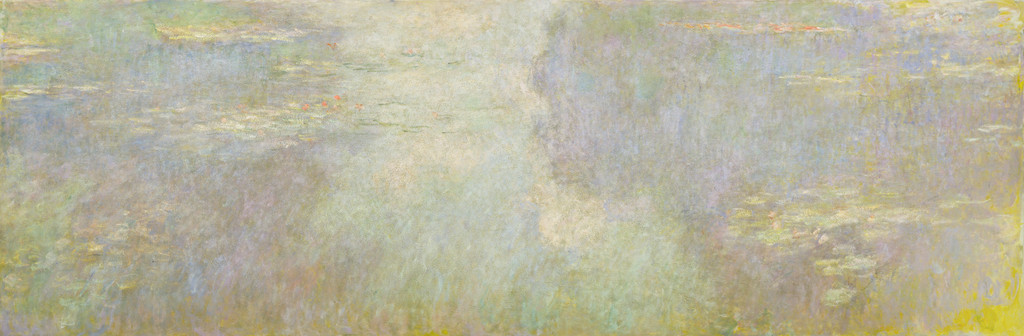
Here is Water Lilies, painted by Claude Monet, between nineteen fourteen and nineteen twenty six. It hangs at the Museum of Modern Art in New York, on the fifth floor, gallery five one five, and the label reads seven one two, dash, nineteen fifty nine.
One thing before you look. This is a large canvas, made to fill your whole field of vision, so give yourself some distance from it first, then let yourself get close. There is often a bench nearby. Use it.
What you are looking at is water. Monet spent his later years painting the pond in his own garden at Giverny, over and over, letting the surface of the water and the lilies floating on it become almost the whole subject. There is no horizon here, no sky you can point to and call sky. Just water, light, and the small shapes of flowers and leaves resting on top of it.
Stand close first. Let the brushwork stop being lilies and become paint again, stroke by stroke, color laid next to color. Then step back, several paces, and watch the same marks pull themselves back into water and light. That shift, up close to far, is the whole experience of this painting. It rewards both distances differently.
Here is what people often miss. This is not really a painting of flowers. It is a painting of looking, of a surface that gives you reflection, depth, and floating things all at once, and never lets you settle on which one you are seeing. Monet was in his seventies and eighties when he worked on these, his eyesight failing, and some say that struggle is part of why the paint gets looser and the color more daring in his last water lily paintings.
Monet painted this same pond hundreds of times across the final decades of his life. This is one version among many, not a single unrepeatable view but part of an obsession, a return to the same water again and again to see what light would do to it next.
So stand where you are, and try both distances. Let the brushstrokes dissolve up close, then watch them settle back into water as you step back. See if you can find the exact point where paint stops being paint and becomes a pond.
A free guide from the Universal Gallery. Read it aloud in your own language on the tool.
Open it in the Universal Gallery →