Vincent van Gogh, The Met, New York
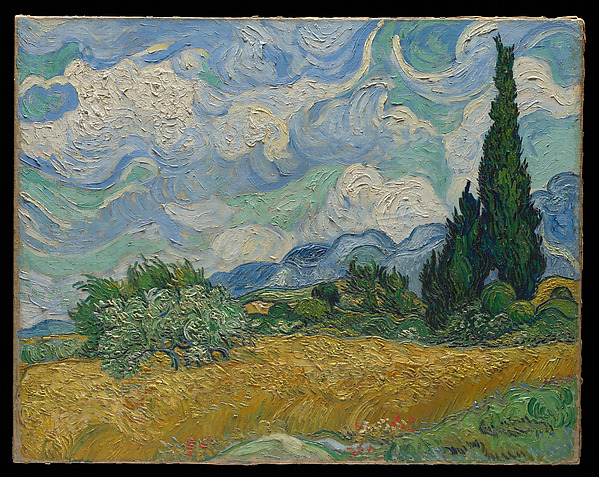
This is Wheat Field with Cypresses, painted by Vincent van Gogh in eighteen eighty nine. It hangs here at the Met, in Gallery eight twenty two, and the label number is nineteen ninety three point one three two, so check that against what is in front of you.
Expect other visitors here. This is one of the paintings people cross the museum to find, so give yourself a moment to wait for a clear view if you need one.
Step in close first. Look at the surface itself, not just the scene. Van Gogh built this with thick, loaded strokes of paint, ridge after ridge, and up close the wheat field and the sky both dissolve into pure motion. You can see the direction his hand moved in.
Now step back. The picture should settle into itself, a field of wheat under a windy sky, with a dark cypress tree rising on the right like a flame that does not move while everything around it churns. Find that tree. It is the one still, vertical thing in a painting that otherwise seems to be blowing sideways.
Here is what is easy to miss. This is not a quiet countryside scene. Van Gogh painted the sky and the wheat with the same kind of urgent, curling brushwork, so the air and the land seem to be made of the same restless material. The cypress holds against it, straight and dark, almost like a figure standing its ground.
He painted this in the south of France, in Saint Remy, during the last active years of his life, when cypress trees had become one of his fixed subjects. He returned to this same field and this same tree more than once that year, in different light and weather, as if he were circling something he needed to understand.
So stand with it a while. Follow one wheat stalk with your eye from the brush marks up close to the shape it makes from a few steps back. Then find the cypress again, and notice how it holds the whole picture steady.
A free guide from the Universal Gallery. Read it aloud in your own language on the tool.
Open it in the Universal Gallery →