🕐 The Factor Clock · for anyone who wants an honest forecast
A prediction clock that never lies to you.
Tell it what you lived. It remembers the hour, watches for the pattern to return, and reads it back to you: the reason, the result, and how sure it honestly is. When it hasn't seen enough, it says so.
Get early access, free →What it does
A library that's earned it
Proven forecasters, two independent weather oracles, a real-money crowd, and more, each trusted only after it beats chance on thousands of real outcomes.
Learns you, privately
Tell it a scenario in your own words and it remembers it at that hour, then asks whether it happened again. Your hours stay on your machine. No account.
A brief that's honest
Every morning, one plain-language read of your day, and it clearly labels a guess a guess, and an earned answer earned.
The face
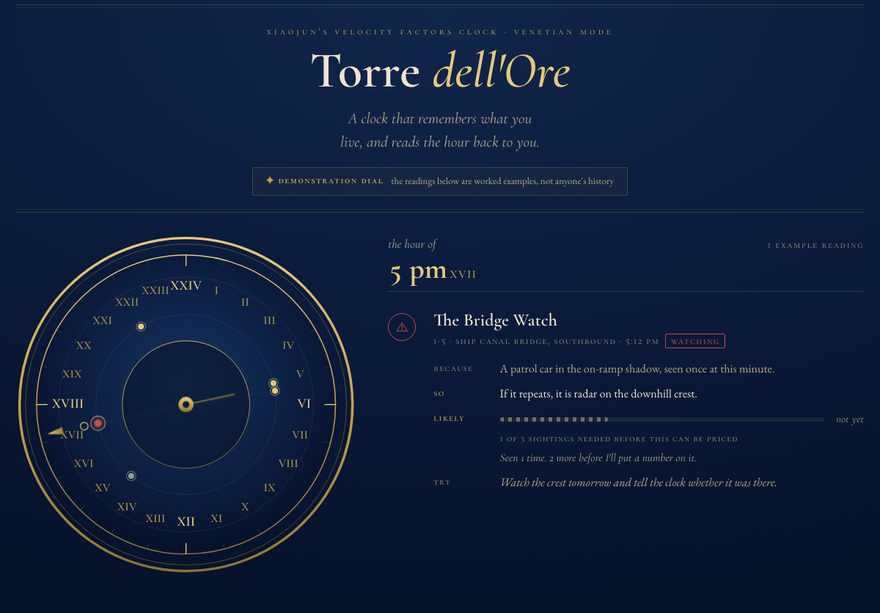
The story it was built for
You sat at the bridge for eight minutes
The next evening, again. The third time you realised it was the same minute, because the bridge goes up for the boats on a schedule nobody told you. That is the whole idea: some hours repeat, and a clock should know which ones. You tell it in plain words, and it reads the hour, the place and the kind out of the sentence.
It works for any hour that repeats. The road past the school at twenty past eight. The queue that runs out of the door when the offices open. The two-thirty slump where nothing difficult gets finished. The last bus that comes early more often than it comes late.
1 · You tell it. “the bridge goes up around 5:10pm on weekdays”
2 · It refuses to guess. “Seen 1 time. 2 more before I'll put a number on it.” No percentage. A dashed bar, not a confident one.
3 · It asks. Each time that hour comes round: it happened, it didn't, or wasn't there. The third answer matters most, because a day you were not looking is never counted as a miss.
4 · On the third sighting it speaks. 87.5%, never 100%, with the range it could really be. The arithmetic will not let three out of three become certainty.
The one thing nobody else ships: honest uncertainty
Every prediction app fakes confidence. This one refuses to. It says “87%, and here's my track record”, or “I don't know, and here's the proof nobody does.” It even keeps a quantum random number generator on the bench under identical rules: if pure randomness ever scores as skilled, it flags itself as broken. That's a tool you can actually trust.
Get it free
- Full access as each piece ships, no card required
- The daily brief + the growing library of proven sources
- Your own private life-tracking & personal predictions
- Every new domain we prove, added free
- Founding members lock in, you'll never pay more than $10